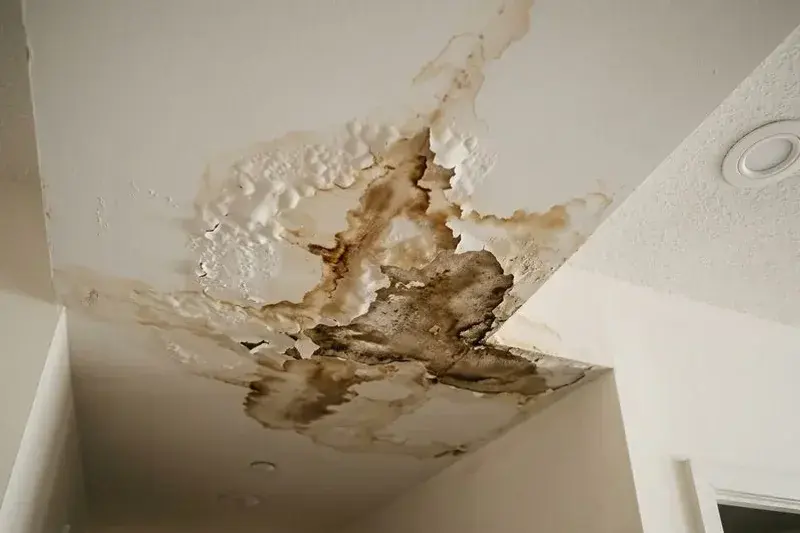
Spring Hill's homes are mostly young, and many are two story houses with the laundry and bathrooms upstairs, so a small leak up there often shows itself as a brown stain on a ceiling below. By the time the stain appears, the water has already crossed the floor, the joist bay and the drywall.
Key takeaways
- Spring Hill grew from 1,464 residents in 1990 to 50,005 in 2020, so its housing is mostly young, much of it two story houses with upstairs laundry and baths.
- A stain or sag on a ceiling means water has already passed through the floor above and the joist bay, so the real damage is larger than the spot.
- Shut off the supply at the fixture or the main, and switch off power to the room below if the ceiling is wet or holding water.
- A ceiling that holds water is opened, the wet insulation comes out, and the cavity is dried before the drywall is replaced.
- The failed hose, valve or fitting is worth keeping and photographing, since it shows the cause for the claim.
Why an upstairs leak shows up downstairs
Water moves down. A leak in a laundry room or bathroom soaks the floor covering first, then the subfloor, then the joist bay under it, and finally the drywall of the ceiling below.
Drywall hides the damage for as long as it can. A faint stain, a bubble in the paint or a small sag usually means the cavity above is already saturated, and a ceiling leak is rarely only as big as the stain.
Humid Tennessee summers slow the drying of anything left wet, which is another reason an upstairs leak is not safe to ignore.
Reading the ceiling: what the stain is telling you
Not every ceiling stain is a plumbing leak. A roof opening or a clogged AC drain in the attic can leave the same mark, so the source has to be traced before anything is repaired.
- A bubble or soft sag: active water is sitting in the cavity right now.
- A brown ring with a darker edge: the drywall has been wet, dried and wet again.
- Peeling paint or tape seams that start to show: the drywall has been damp for a while.
- A musty smell with no stain: water may be sitting in the insulation above.
- A drip from a light fixture or fan: switch the breaker off before going near it.
Where upstairs leaks come from
Upstairs laundry rooms and baths put several water sources directly over finished ceilings, and each one fails in its own way.
- Washer supply hoses and drain connections behind the machine
- Tub and shower seals, overflow gaskets and drain connections
- Toilet supply connections and wax rings
- Supply pipe fittings inside the wall or floor, which can fail without warning
Hoses and appliances
A washer hose that bulges, rusts at the coupling or weeps at the faucet is close to failing. Appliance and supply hose leaks can run unnoticed while the house is empty, which lets a slow drip become a soaked floor.
What to do when a ceiling stains or sags
Speed matters, but safety comes first, because a wet ceiling can fall and wet wiring can shock.
- Stop the source: Close the shutoff at the fixture, or the main water valve if the source is unclear.
- Cut power: Turn off the breaker for the room below if the ceiling is wet or a light fixture is dripping.
- Protect the floor: Move furniture away and set buckets and plastic sheeting under the wet area.
- Relieve a bulge: With the power off, a small hole at the lowest point of a bulging ceiling, away from fixtures, lets the water drain into a bucket instead of bringing down the whole panel.
- Photograph: Record the stain, the source upstairs and the floor above before anything is cleaned.
- Keep the part: Save the failed hose, valve or fitting for the adjuster.
How the ceiling and the joist bay are dried
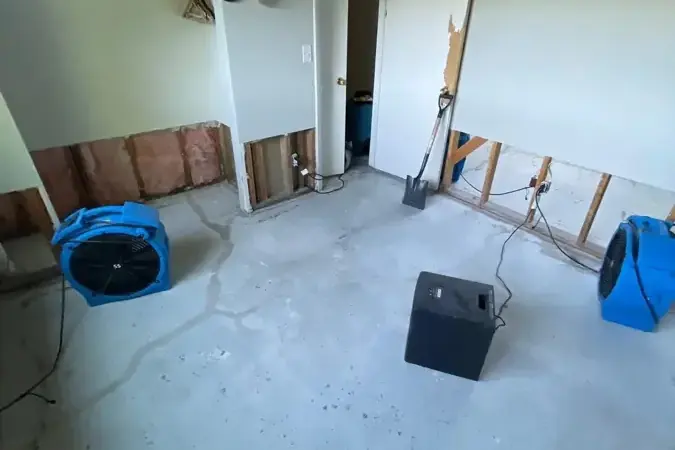
The tech who does the walkthrough takes moisture readings in the ceiling, the walls and the floor above to see how far the water traveled. Wet insulation is removed, because it holds water against the framing, and saturated drywall is cut out in clean sections so the cavity can open up.
From above: the floor
Water extraction pulls standing water off the laundry or bath floor, and wet carpet pad or flooring comes up if it cannot dry in place.
From below: the cavity
Air movers and dehumidifiers dry the joists and the subfloor, and readings are taken every day until the framing is close to a dry reference. That is the heart of structural drying, and it is why a ceiling is not patched until the numbers say dry.
What gets replaced and what stays
The aim is a ceiling repair that lasts, which means nobody paints over a stain while the cavity is still wet.
- Ceiling drywall that is stained, sagging or soft: replaced
- Insulation that took on water: removed and replaced
- Joists and subfloor: dried, not replaced, once readings reach the dry reference
- Paint and texture: redone last, after everything is dry
The claim and the paperwork
Sudden leaks from a hose, a supply connection or a failed fitting are generally covered by a homeowners policy, while long term seepage often is not. The start date and the cause both matter, which is why the photos and the failed part count.
The drying team's moisture readings and daily logs show the structure was dried to standard, and an itemized list of what was removed supports the claim. A renter should tell the landlord or property manager in writing right away, with photographs, and keep a copy.
A claim file for a ceiling leak usually holds these items:
- Photos and video of the ceiling, the source and the floor above
- The failed part, bagged and labeled
- The date the stain was first noticed and the date the water was shut off
- Moisture readings and equipment logs from the drying team
- Receipts for plumbing repairs and temporary housing
Questions
How long can a ceiling stain wait before it needs attention?
Not long. A stain means the cavity above is already wet, and wet insulation and framing keep holding water. Stop the source first, then have the ceiling opened and dried.
Can a stained ceiling just be painted?
Not while the cavity above is wet. Paint hides the stain but not the moisture, so the stain returns and the drywall and framing keep taking damage.
Is it safe to poke a hole in a bulging ceiling?
With the power off to that room, a small hole at the lowest point of the bulge, away from lights and fans, lets trapped water drain into a bucket. Stand to one side while doing it, since the panel can drop.
Does homeowners insurance cover a ceiling damaged by a washer hose?
A sudden hose failure is generally covered, while slow seepage over a long time often is not. Read the policy wording and report the loss promptly.
What does a ceiling repair involve after the leak is fixed?
The wet insulation and soft drywall come out, the joists and subfloor are dried to readings near a dry reference, and only then is new drywall hung, textured and painted.