Structural Drying and Dehumidification in Fairview, TN
After the standing water is gone, moisture stays in studs, subfloors and framing. Dehumidifiers and air movers dry the structure under controlled conditions, and daily readings show when it is truly dry.
(888) 849-5796Fairview drying help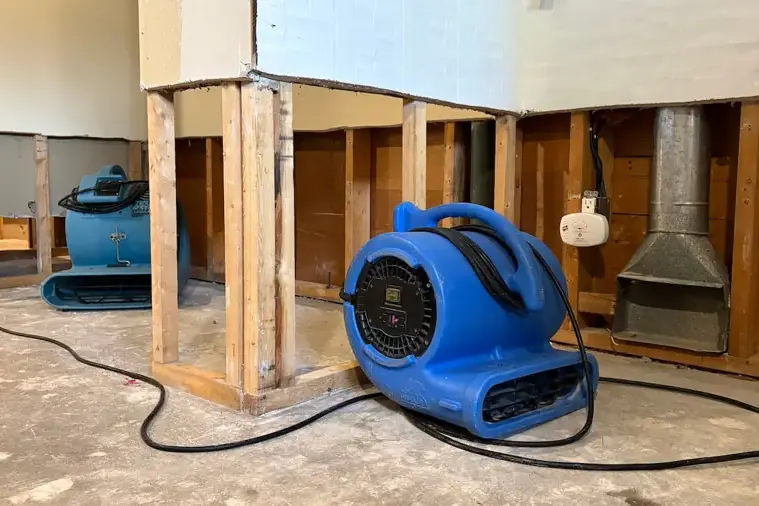
First steps for structural drying and dehumidification in Fairview
- 1
Keep the heat steady
Leave the thermostat at a normal indoor temperature so warm air helps moisture evaporate, and do not open windows.
- 2
Leave the equipment alone
Do not turn off or move dehumidifiers and air movers. They run continuously, and unplugging them stalls the drying.
- 3
Empty the collection tanks
If a unit has a collection bucket, empty it when it fills, and keep furniture and belongings clear of airflow paths.
- 4
Keep the record going
Save photos, readings handed over after each visit and any receipts so the claim file stays complete.
How structural drying and dehumidification is handled in Fairview
Pulling out standing water is only the first half of a water loss. Wood, drywall and subfloor hold moisture long after they stop looking wet, and that moisture feeds odor, warping and mold if it is left. Structural drying is the controlled process of removing it, using equipment sized to the room and readings that show progress instead of guesses. It happens after extraction and before rebuilding, and it decides how much of the structure can stay.
What does structural drying and dehumidification cost in Fairview, TN?
Structural drying in Fairview runs about $500 to $1,200 for one room, $1,200 to $4,500 for several rooms, and $4,500 to $12,000 for Class 4 or large losses.
One room
- A Class 1 or 2 loss
- Air movers and a dehumidifier
- Readings at each visit
Several rooms
- A Class 2 or 3 loss
- LGR dehumidifiers with air movers
- Daily psychrometric log
Class 4 or large loss
- Dense materials such as hardwood
- Desiccant and drying mats
- Extended monitoring visits
Ranges are typical, not a quote: the category of water, square footage, material class and how fast drying started move the number most. Run the water damage cost calculator for a closer range.
The structural drying and dehumidification process in Fairview
Measure and classify
Moisture content, temperature and humidity are logged, and the loss is classed from 1 to 4.
Set equipment
LGR dehumidifiers, air movers and mats are placed to move air across every wet surface.
Monitor daily
Readings are repeated at each visit, and equipment is moved or added where drying lags.
Reach the target
Drying ends when wet materials match the dry reference, and the log goes to the claim file.
Structural Drying and Dehumidification in Fairview: what to know
Why Fairview homes need measured drying
An estimated 992 homes in Fairview date from 1990 to 1999, and the median home was built in 1997, so many wall cavities and subfloors are decades old. After a pipe failure, or creek flooding like the early December 2022 event, those cavities and the framing around them need controlled drying so moisture does not stay in the structure. A wall can stay damp for a long time behind paint and trim, which is why readings, not appearance, decide when drying is finished.
How drying is set up
The drying plan is built from the first set of readings.
- Class 1 or 2 loss: air movers and one dehumidifier in the room
- Class 3 loss: LGR dehumidifiers and extra air movers
- Class 4 loss: drying mats or desiccant for dense materials
- Doors and openings closed so humidity stays controlled
Class describes how much water the materials absorbed and how fast it will evaporate. Higher classes need more equipment and longer monitoring.
Containment keeps conditioned air inside the wet area, so doors, vents and openings are closed or sealed while the equipment runs.
Daily readings and adjustments
At each visit the tech logs moisture readings from wood and drywall, then the temperature and humidity of the room air and the dehumidifier output. If one wall dries slower than the rest, air movers are repositioned or the cavity is opened. Drying is finished only when wet materials match the dry reference taken from an unaffected part of the home.
The drying time estimator shows how those variables change the schedule.
What comes after drying
Once readings match the dry reference, equipment is removed and the log is added to the claim file. Rebuilding with new drywall, insulation and flooring can then begin, and larger repairs may involve building permits issued by Fairview's Codes Department through its GovWell portal. See water extraction in Fairview for the step that comes first.
Structural drying and dehumidification across Fairview and nearby communities
Structural drying runs wherever water reached in Fairview, from Heartland Reserve and Kyles Creek to Cumberland Estates, Aden Woods and Clearview Meadows and the multi-family housing along Fairview Boulevard, with equipment sized to each home and every wet room inside it.
The same service nearby: structural drying and dehumidification in Spring Hill, Thompson's Station, Columbia.
Related water damage services in Fairview
Structural Drying and Dehumidification questions in Fairview, TN
Still wet in Fairview?
Walls or floors still damp after the water is gone? Describe what you see and the crew explains how the drying is measured.
(888) 849-5796 Ask a Fairview drying questionHow long does structural drying take?
It depends on the materials, the class of loss and the water involved. Dense or finished materials dry slowly, and the readings, not a calendar, decide when the equipment can come out.
Why are the machines so loud and so many?
Each machine does a different job. Dehumidifiers pull water from the air, and air movers push dry air across wet surfaces. Together they dry faster than either alone, and the count depends on room size.
Can drying be done without removing drywall?
Often, for clean water caught early. Directed air and small openings can dry a wall in place. Contaminated drywall or insulation that has soaked through is removed instead.
Is wet insulation or subfloor dried or replaced?
Subfloor and framing are dried, because solid wood recovers. Fiberglass insulation that has soaked is usually replaced, and swollen particleboard or crumbling drywall cannot be saved.
When is drying actually finished?
When readings in the wet materials match the dry reference taken from an unaffected area. A floor that feels dry to the touch can still hold moisture below the surface.
Damp walls in your Fairview home?
The crew sets equipment, takes daily readings and removes it only when wet materials match the dry reference.
(888) 849-5796Call about Fairview structural drying