Structural Drying and Dehumidification in Thompson's Station, TN
Water that soaks into framing and subfloors does not dry by itself. The drying team measures the structure, sets dehumidifiers and air movers, and logs readings until every material is dry.
(888) 849-5796Call about drying wet walls and floors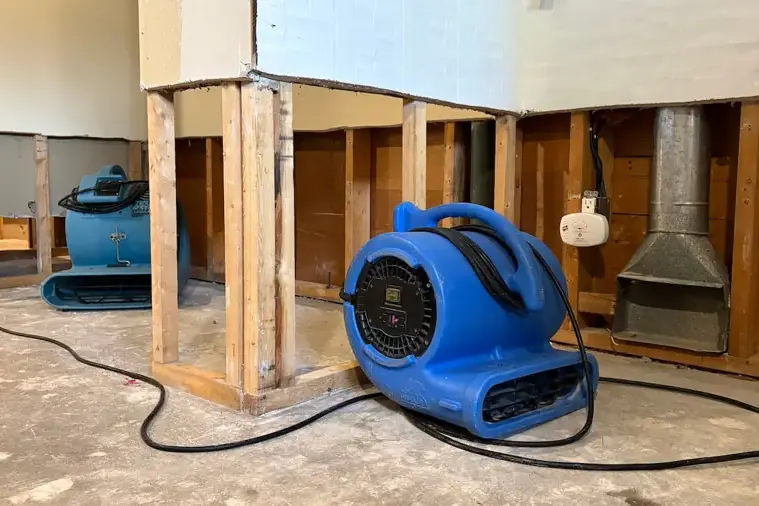
First steps for structural drying and dehumidification in Thompson's Station
- 1
Stop the source
Close the valve or stop the leak, and remove standing water so drying equipment is not working against a flood.
- 2
Open the wet areas
Let the crew cut small openings at wall bases and remove wet insulation so air can reach the cavity.
- 3
Leave the equipment on
Keep air movers and dehumidifiers running and do not turn them off or move them between visits.
- 4
Close windows and doors
Keep the home closed so humid outside air does not undo the work of the dehumidifiers.
How structural drying and dehumidification is handled in Thompson's Station
Surface water is the visible part of a water loss, and the bigger share often sits inside framing, subfloors and wall cavities. After a pipe failure or a creek flood like the one reported along Kennedy Creek near Thompson's Station on August 8, 2026, drying is a measured process rather than a matter of running fans and waiting.
What does structural drying and dehumidification cost in Thompson's Station, TN?
Structural drying runs $500 to $1,200 for one room, $1,200 to $4,500 across several rooms, and $4,500 to $12,000 for a Class 4 or large loss.
One room
- One wet room, light soaking
- A few air movers, one dehumidifier
- Readings at each visit
Several rooms
- Walls and ceilings also wet
- LGR dehumidifiers with air movers
- Daily moisture and humidity logs
Class 4 or large loss
- Hardwood, plaster or concrete
- Desiccants and drying mats
- Longer monitoring period
Ranges are typical, not a quote: the category of water, square footage, material class and how fast drying started move the number most. Run the water damage cost calculator for a closer range.
The structural drying and dehumidification process in Thompson's Station
Read and map
Moisture meters, a thermal camera and a hygrometer record where water went and how wet it is.
Set the equipment
Air movers, dehumidifiers and mats are placed to match the class of loss and the room layout.
Check each day
Readings are retaken, equipment is moved or removed, and the log shows the trend.
Finish and file
Dry targets are met, the equipment goes out and the full record is handed over for the claim.
Structural Drying and Dehumidification in Thompson's Station: what to know
How drying is measured
The drying team starts with moisture readings on every wet surface, plus the temperature and humidity of the air. Those numbers set the equipment plan and become the starting point for the daily logs. A dry reference reading from an unaffected part of the home gives the target, so drying stops when the wet materials match it and not before.
Equipment and what it does
Each piece has a job, and placement follows the readings.
- Air movers push dry air across wet surfaces
- Dehumidifiers pull moisture out of the air
- Drying mats lift water from hardwood and subfloor
- Cavity systems push air into opened wall bays
Fans alone move damp air around a room, which is why dehumidifiers are paired with air movers on any loss beyond a small spill.
Loss classes and why they matter
Drying plans are sized by class. A Class 1 or 2 loss touches little material or a whole room's carpet and pad, while Class 3 soaks walls and ceilings and Class 4 involves dense materials such as hardwood, plaster or concrete that release water slowly. Higher classes call for more dehumidifier capacity, specialty tools and longer monitoring, which is why price ranges climb with the class.
Why newer homes still need it
About two thirds of the housing units in Thompson's Station, an estimated 1,998 of 3,034, were built in 2010 or later, and a newer home is no exception once water is inside a wall. Insulation, drywall and framing hold moisture in any house, so the same readings, equipment and daily checks apply whatever the age of the home.
Monitoring and finishing
Technicians return daily to re-read each wet material and move equipment as areas dry, because a fixed setup wastes energy and leaves pockets damp. When every reading reaches its dry target, the equipment is removed and the logs are saved for the claim. For a first idea of the length, try the drying time estimator; standing water is handled earlier by water extraction.
Structural drying and dehumidification across Thompson's Station and nearby communities
Structural drying work reaches Tollgate Village, Bridgemore Village, Fields of Canterbury, Allenwood, Avenue Downs, Whistle Stop and Cameron Farms, plus Town Center and the Heritage Commons Commercial District. Equipment is placed room by room wherever the readings call for it.
The same service nearby: structural drying and dehumidification in Spring Hill, Columbia, Fairview.
Water damage restoration in Thompson's Station Every town covered
Related water damage services in Thompson's Station
Structural Drying and Dehumidification questions in Thompson's Station, TN
Still wet in Thompson's Station?
Wet walls and floors need more than fans and time. Tell a Thompson's Station water damage pro what got wet and how long ago.
(888) 849-5796 Ask about drying equipmentWhy not just run fans?
Fans move air but do not remove moisture from it, so humidity stays high and wet framing keeps absorbing it. A dehumidifier matched to the space does the actual removing.
How does the crew know when it is dry?
Readings on wet materials are compared with a dry reference reading from the same type of material elsewhere in the home. When they match, the target is met.
Does the equipment have to run all the time?
Yes, until the readings say otherwise. Stopping early leaves moisture inside walls and subfloors, and the equipment is only removed after the final readings are logged.
What does Class 4 drying involve?
Dense materials such as hardwood, plaster and concrete release water slowly. Desiccant units and drying mats pull it out, and monitoring runs longer than on a simple loss.
Can drying start before the claim is approved?
Mitigation is usually started right away, because waiting lets damage grow. Photos, readings and the equipment log document the work so the insurer sees what was done.
Does the house need to stay closed up?
Yes. Open windows let humid air in and undo the dehumidifier work. The drying team explains which rooms stay sealed and which doors can open.
Walls and floors still damp?
The mitigation team can read the structure, set the equipment and log every visit until it reaches dry targets.
(888) 849-5796Thompson's Station structural drying help